Posts

Showing posts with the label Stories

The Never-Dry Spring at Thiruvanaikaval

Image
The famous Jambukeswarar Temple is located in Thiruvanaikaval, a suburb of the town of Tiruchirappalli on the northern banks of the Kaveri river that surrounds, along with river kollidam, the Thiruvanaikaval-Srirangam Island. As an appu-sthalam , it is one of the Pancha Bhoota Stalams , and Shiva is venerated here as Jambukeshwara, an embodiment of the element water(appu). The spring underneath the lingam never goes dry even in the driest season. According to the puranas, there was once a forest of jambu trees in the place of modern Tiruvanaikkaval. Lord shiva appeared as a Lingam under one of the trees that came to be called the Jambulingam. Nearby was a tank called Chandratirtha which was filled by water from the river Cauvery. There is a legend that Parvathi worshipped Shiva here and installed the idol in the sanctum. Even today at noon the 'Archakar' dresses like a woman and does Pooja to Jambukeswara and to a special variety of black cow called Karam Pasu.

சிவபெருமான் தோழர் சுந்தரரும் அருணகிரி நாதரும்

You can read here the story of Paravai Nachiyar in English " பரவைக்கு எத்தன ை" என்று தொடங்கும் பொதுப் பாடலில், தன் அடியார்களுக்காக எதையும் செய்யத் தயங்காத மாண்பு கொண்டவர் அந்த மகாதேவன் என்பதையும், சுந்தர மூர்த்தி நாயனாரின் நண்பனாகவே தன்னை ஆக்கிக் கொண்டவர், கந்தனின் தந்தை என்பதையும் பாடிப் பரவசம் ஆகிறார் அருணகிரியார். பரவைக் கெத்தனை விசை தூது பகரற்கு உற்றவர் மாண் " ஒரு பெரிய புராணத்தையே உள்ளடக்கிய வரிகள். உரிமையால் பக்தன் உத்தரவிட, கருணையால் அதைச் செய்து முடிக்கும் பரமன். பழைய சிவ அடிமை சுந்தரர் ப்ராரப்தம் முடித்து முக்தி பெற எடுத்த பிறவி. சிவபக்தைகள் இருவர், பரவை நாச்சியாராகவும், சங்கிலி நாச்சியாராகவும் பிறந்து, சுந்தரரைக் கை பிடிக்கக் காத்திருக்க, இறைவன் திருவருளால் இகபர சுகம் பெற, திருவாரூரில் பரவையையும், திருவொற்றியூரில் சங்கிலியையும் மணம் புரிந்து கொள்கிறார் வன் தொண்டர் சுந்தரர்.

The Amazing Arunachala Mountain At Thiruvannamalai

Image
Annamalaiyar Temple is located at the base of Annamalai hills in the town of Thiruvannamalai. The 2668-feet Annamalai mountain is considered an enormous Shiva Lingam. The mere thought of Annamalai mountain bestows salvation to the meditator. That is why many sages worship and circumambulate the mount reverentially. This mountain, with tremendous magnetic power, has existed ever since the earth came into existence. While the Indian subcontinent’s most famous mountain range formation, the Himalayas, is less than 50 million years old, scientific and geological research led by Professor Kent C. Condie, of New Mexico Institute of Mining and Technology, found that the Archaean rock formation of Arunachala belong to the Proterozoic age and is more than 2.5 Billion years old. In the Krita Yuga this was a fire mountain; in the Treta Yuga, a ruby mountain; in the dwapara yuga, a golden mountain; and in the kali yuga, a stone/granite mountain.

Devi's Penance In Kancheepuram

Image
The sthalapurana of Ekambareswarar Temple at Kancheepuram says that when Lord Siva was deeply immersed in the task of creating, protecting and destroying the Universe, His consort Parvati playfully closed his eyes. The momentary closure caused eons of darkness for the Gods. To prevent similar incidents from recurring, Parvati Devi expressed to Shiva that she should unite with Him in a single form and Shiva agreed. Shiva used the occasion as a divine ploy to set an example of righteousness in atoning for causing harm to others, even if done unknowingly. He asked Parvati to do penance at Himalayas, Benaras, Kanchipuram and finally at Thiruvannamalai where He would yield His left side and unite with Her.

The Legends of Kalahasthi

Image
Kalahasteeswara temple stands on the banks of River Swarnamukhi at Kalahasthi, also called Dakshina Kailasam and Dakshina Kashi. Krishnadeva Raya, emperor of the Vijayanagara Empire, built this 135-foot high temple in 1516 AD and its seven-storeyed-gopuram, following the successful Kalinga war in which he vanquished the Gajapati kings of Orissa. Of the five pancha bhoota sthalas representing the five elements, this temple represents the element Wind. This temple is known for Sarpadosha Nivaarana Pooja performed for propitiating the serpents Rahu and Ketu . According to ancient Tamil sources, SriKalahasti has been known as the ‘Kailas of the South’ and the small river Swarnamukhi on whose banks it sits, the ‘Ganges of the South'. The temple has a statue of the hunter Thinnan who offered his own kann (eyes) to this Shivalinga and became renowned as Bhakta Kannappa. In days of yore, a spider (sri), serpent (kala) and elephant (hasti) elephant worshipped Shiva with great devotion, ...

Shiva as a Bangle Seller

Once Lord Shiva wanted to expunge the ignorance of sages of Tharugavanam (deodar/pine forest) and lead them to true knowledge, and also to show the limits of chastity of their wives. With sacred ashes smeared over His body, He disguised Himself as a mendicant (Bhikshatana), he reached the forest. The wives of the sages came out of their homes to give alms. They were overwhelmed by the charm of the mendicant. With melting desire in their hearts, their bangles loosened and fell down into the mendicant's bowl, and their dress slipped down as they gazed at him in awe and longing. As the mendicant moved away taking away their bangles, the women realized the impropriety of their actions and begged Him in vain to return their bangles.

The Ascetics Who Witnessed The Ananda Thandava At Thillai

Lord Adishesha once heard about Shiva's Ananda Thandava from a rapturous Vishnu who recalled the ecstasy He felt while witnessing the dance at Darukavanam. Adi Shesha begged his Lord Vishnu's permission to go and see the Cosmic dance for himself. After performing strenuous tapas, Shiva promised that he would be able to witness His dance at Chidambaram and blessed him with the boon of being born a son to the sage Atri and his wife Anasuya. Anasuya was frightened to see the baby with a half snake form, and she dropped him from her hands out of shock. From there came his name Pata-anjali, Patanjali, Fallen from Folded Hands. At this time, Rishi Madhyandina (one of the fifteen disciples of Sage Yajnavalkya) who lived on the banks of the Ganga, directed his son to go to Thillai forest and pray to Lord Shiva. The son started praying to the Swayambhu linga under a banyan tree near a tank in the same forest. He used to collect flowers for puja and he prayed for the boon of getting t...

Why Shiva Danced At Thillai

Long ago, the sages in Daruka forest had become arrogant, having acquired immense powers by performing severe penances. The rishis followed the school of purva-mimasa of the Vedas. They denied that there was any principle except Karma and believed in the assured efficacy of rituals. They rejected the existence of a Supreme Being and deluded themselves into believing that they were the architects of their own destiny. Their wives were conceited about their ostensible chastity and loyalty to their husbands. Vainly thinking that God can be controlled by rituals and 'mantras', they began creating havoc on earth. Lord Shiva, with the help of Lord Vishnu, made a plan to put an end to this misery. They went to Daruka Vana, Shiva appearing as a naked mendicant ( bhikshatana ) and Vishnu, as His enchanting wife.

The Story of Pulavar Poyyamozhi

A poet in South India by name Poyyamozhi Pulavar or Siva Kavi had intense devotion for Lord Siva, and refused to sing the glory of Lord Shanmukha, stating he would sing on cock (Siva), not on chicken (Murugan). ' சேவலை பாடும் வாயால் கோழிக்குஞ்சை நான் பாடுவேனோ ' The Lord wanted to protect him and so took the form of a hunter and chased the poet. When the latter pleaded for relief, the hunter asked him to sing on him. The poet asked for his name. The hunter said it was 'egg' ( muttai ).

How Sundaramoorthy Nayanar Brought A Dead Boy Back To Life

The story of how Saint Sundarar brought back to life an eight-year-old boy who had died a few years ago is one of the stories that appears in the Thiruvilaiyadal Puranam. When Sundarar was going to the temple at ThiruPukkoliyur (now known as Avinaasi), near present-day coimbatore, he heard two discordant notes coming from opposite houses – one echoing joy and the other sorrow. When Sundarar enquired, he found out that each of the houses had a son. The two sons had been friends and had gone to the river together. But while one boy was swallowed by a crocodile, the other boy had survived. And after three years, the parents of the surviving boy were happily conducting Upanayanam (Thread ceremony) for their son, while the parents of the dead were wailing over their departed son. Hearing this story, Sundarar went to the place where the boy was swallowed by the crocodile. He sang a pathigam (poem in praise of a deity consisting generally of ten stanzas ), worshiping Lord Shiva to resurrect...

Story of How Ravana Tries to Lift Mount Kailasa

Once, after defeating Kubera, his step-brother, King Ravana was returning from Alakapuri to Lanka in a Pushpaka Vimana. On the way, he had to cross Mount Kailash where Lord Shiva and Parvati devi were enjoying their private moments. To his surprise, Ravana found that he couldn't cross the mount, and Nandi, Shiva's attendant, politely asked Ravana to change course. Infuriated, Ravana decided to uproot the Kailash mountain. As he proceeded to lift it, Kailash began to shake, and a terrified Parvati embraced Shiva. However, the omniscient Shiva realized that Ravana was behind the menace and pressed the mountain into place with his big toe, trapping Ravana beneath it. Ravana gave a loud cry in pain. Since Ravana cried, he was given the name "Ravana" – one who cried. ( parimaLa migavuLa )

How Sambanthar Drank Goddess Parvati's milk

In the old city of Seerkazhi in Tamilnadu, lived a brahmin by name Sivapadahrudaya. He and his wife Bhagavathi Ammal were ardent devotees of Shiva, the presiding deity Thoniyappar of Seerkazhi. In course of time Bhagavathi Ammal gave birth to a boy baby who was named Sambandan. One day when his father was going to the temple as usual, little Sambandan joined him. When they reached the temple, Sivapadahrudaya wanted to take a dip in the holy pond of the temple Brahma Teertham. He left Sambandan on the banks and told him to be there until he returned after his holy dip. When Sivapadahrudaya took long to come back, he cried out in anguish. Parvati descended to where Sambandan was and fed him milk from a golden cup. By that time the father had finished his dip and came up. He saw milk drooling from the mouth of Sambandan and got very angry that his little son had taken milk from somebody. He angrily asked his son who gave him milk. Just then Lord Shiva and Parvati appeared in front o...

How The Goat Came to Be Murugan's Vahana

Sage Narada performed a yagna to appease Lord Siva. Suddenly from the fire sprang a fierce and uncontrollable goat with formidable horns, striking terror into all the gods and shaking the mountains.

How Shiva Slayed Gajasura

One of the Namas of Shiva is Krittivasa ("who has skin as his garment"), a name that refers to His slaying of Gajasura and wearing his hide/skin on his body. Another Nama is Gajaha, the slayer of the elephant. According to the Shiva Puranas Gajasura is the son of the Mahishasura, the buffalo demon who was killed by Goddess Durga. To avenge his father's death, he is said to have performed a penance. Lord Brahma was impressed and granted him a boon that he would be killed only by a Jitendriya, one who has overcome all lust and desires. Thinking that he was invincible, the demon harassed the people of the Earth, asking them to worship him instead of the Gods. He went to Benares and attacked the sages who prayed to Lord Shiva for help. Shiva emerged from this linga, slew the demon, skinned the animal and wore its hide around his body. Reference To This Story in Thiruppugazh கரித்தோல் உரித்தார் விரித்தார் தரித்தார் (சரத்தே உதித்தாய்) கரி புராரி

The Laws of Karma and The End Days of Lord Krishna

In the Thiruppugazh Eluppunaadi , we have the lines that refer to an important event in the life of Krishna: உலக்கை ராவி நடுக்கடல் விட்டவன் மருகோனே (ulakkai raavi nadukkadal vittavan marugonE). The Krishnaavatara shows the essence of Karma yoga as a path to attain salvation, and Krishna exemplifies this by living His life as a Karma Yogi. He accepts the consequences of Karma with equanimity and dies at the hands of a hunter. Yes, the laws of Karma are universal and applies to gods as well. According to Mahabharata, the Kurukshetra war resulted in the death of all the hundred sons of Gandhari. On the night before Duryodhana's death, Lord Krishna visits Gandhari to offer his condolences. Gandhari feels that Krishna knowingly did not put an end to the war, and in a fit of rage and sorrow, she curses that Krishna, along with everyone else from the Yadu dynasty, would perish after 36 years. Krishna himself knew and wanted this to happen as he felt that the Yadavas had become very haugh...

Surpanakha and Vibhishana: Why Arunagirinathar Refers to Surpanakha As Vibhishana's Sister

In the poem தாக்கமருக்கொரு ( thakkamarukkoru ), Saint Arunagirinathar refers to Surpanakha as Vibishana's sister. As a demoness who was the cause behind Sita's abduction, it would have been more appropriate to refer to her as the treacherous Ravana's sister. After all, Vibhishana was virtuous and had nothing in common with Surpanakha. But the bard was looking for reasons behind Surpanakha's disfigurement by Lakshmana and refers here to a popular story about the past lives of Vibhishana and Surpanakha.

The Story of Nakkeerar and Thirumurugatruppadai

Nakkeerar lived in the 9th century AD during the Sangam period. His devotion for Lord shiva and Murugan are depicted in ThiruviLaiyAdal purANam and are enacted as a part of the Meenakshi Sundareswarer Temple festival celebrations at Madurai. As related in Tiruvilaiyadal Puranam, the Pandiyan king was strolling in the royal garden. As he smells the flowers, he wondered whether women had naturally fragrant hair or whether the fragrance came from the flowers. He announces a prize of 1000 gold coins for anyone who could resolve his doubt. A poor poet named Tharumi prays to Lord Shiva to make him get the reward. The Lord gives him a poem and asks him to take it to the King. கொங்குதேர் வாழ்க்கை அஞ்சிறைத் தும்பி காமம் செப்பாது கண்டது மொழிமோ பயிலியது கெழீஇய நட்பின் மயிலியல் செறியெயிற் றரிவை கூந்தலின் நறியவும் உளவோ நீயறியும் பூவே.

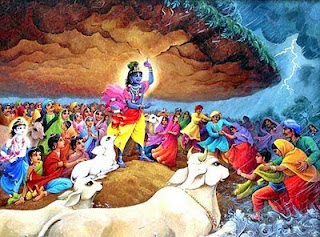
Why Lord Krishna Lifted The Govardhan Mountain On His Little Finger

Image
Govardhana is a 8km long hill located near the town of Vrindavana in the Mathura district of Uttar Pradesh. It is believed that thousands of years ago, Lord Krishna lifted up this hill and held it over His head with his little finger for 7 days to protect the inhabitants of the town from the wrath of rain God Indra. It was customary for the people of Vrindavan to pay annuual tribute and obeisance to Indra for bringing them good vegetation and greenery, thus providing them and their cattle with abundant food. When Krishna saw the preparation for this annual event, he debated with his father and the villagers whether this was indeed necessary. He felt that all human beings should merely do their 'dharma' to the best of their ability and not pray or conduct sacrifices for natural phenomenon. He told them to worship the Govardhan mountain as it was His own manifestation.

How Thirugnana Sambanthar Cured The Pandyan King and Defeated The Jain Monks

Tirugnana Sambanthar is one of the most prominent of the sixty-three Nayanars who lived between the 6-9 CE. His poems form the first three volumes of the Tirumurai, the religious canon of Tamil Saiva Siddhanta. In the first half of the seventh century, apart from Saivism, Jainism and Buddhism were among the popular faiths in south India. The king Koon Pandian had embraced Jainism, but the queen Mangaiarkkarasi and his minister Kulachirai Nayanar were both Shaivites. The King became a Jain fanatic and did not permit the queen even to wear Thiruneeru on her forehead. Hindus suffered persecution and having converted the king, the Jain monks started to wield greater power in the kingdom. The queen and the minister minister Kulachirai Nayanar were struggling to find a way to get rid of Jainism and bring Shaivism to its former glory in the kingdom. During this time, the queen heard the news that Appar and Sambandar had performed the miraculous task of opening and closing the doors of the...

When Krishna Made Day Into Night

Image
Jayadratha, the king of Sindhu, and the husband of Dhritarashtra's only daughter Dushala, sides with Duryodhana in the Kurukshetra War. Jayadratha once tries to abduct Draupadi while they were serving the 12-year exile in the forest, but is held captive by the Pandavas who leave him alive after shaving his head. Desiring to avenge his humiliation, Jayadratha performs penance and. as a boon, asks Shiva for the power to defeat the Pandavas. Shiva grants Jayadratha the power to hold all the Pandava brothers at bay for one day in battle - all except Arjuna. Jayadratha's father, Vriddhakshatra hearing a incorporeal prophecy that his son's head would be beheaded, obtains a boon that the head of the person who causes his son's head to fall on the ground would get blown up.